Mobile tour now available

I’m not much of a hand at writing press releases, but the prototype mobile tour that we’ve just finished seemed to need one:


Classicizing Philadelphia announces the release of a mobile tour of classically themed sites in Philadelphia. The tour can be accessed on mobile devices (smartphones and iPads or similar tablet computers) by directing an Internet browser to

classicizingphiladelphia.org/mobile

The mobile tour guides users around a group of important buildings within a few blocks of Independence Hall that reveal ways in which architects from the 1790s until the Civil War used elements of classical Greek and Roman architecture to house the institutions of a growing nation. Classicizing Philadelphia plans to develop a series of mobile tours and customizable tour stops documenting Philadelphia’s long engagement with Greece and Rome.

Classicizing Philadelphia is a digital humanities and public history project based at Bryn Mawr College and supported by the Classical Association of the Atlantic States. It seeks to document, study, and continue Philadelphia’s long conversation with ancient Greece and Rome. Technical development is provided by Interactive Mechanics. Content for the prototype mobile tour was created by Classicizing Philadelphia project director Lee Pearcy and Bryn Mawr graduate student Megan Dickman.

Further information: classicizingphiladelphia.org or e-mail lpearcy@brynmawr.edu
Cleaning up classical for the Pope

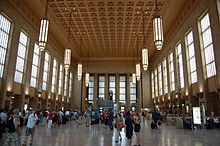
Philadelphia has many more elegant and better situated neoclassical buildings than 30th Street Station.  From the outside, the station is basically a rectangular box with a Corinthian portico tacked on at either end, flanked by wings whose plain, Depression-era pilasters look as though they belong to a different building altogether. It is hemmed in by a river, parking lots, and the Schuylkill Expressway. But to someone arriving by train from another city, the inside of the central box—the great, golden space that opens up at the top of the escalator—offers one of Philadelphia’s best welcomes and is certainly an improvement over the airport of hell known as Penn Station in New York.

220px-Amtrak30thStreetStationInterior2007

In September Philadelphia will welcome Pope Francis, and then the Democratic national convention comes to town in July 2016.  It’s time to get the magazines off the coffee table and polish the silver.  The Philadelphia Inquirer reports that Senator Bob Casey (D. Pennsylvania) has urged Joseph Boardman, president of Amtrak, “to put into motion a plan for revitalization of the station’s interior.”  Gerard Sweeney, the head of Brandywine Realty Trust, is somehow part of this conversation.  Brandywine, whose elegant Cira Center skyscrapers flank the station, is working with Drexel University to develop plans for the area around the station, and Sweeney would welcome a makeover of 30th Street’s interior: high-end retail, better signage and lighting, renovated waiting areas, and so on.

These are all good ideas (although I hope they keep the long wooden pews in the main waiting room–some of my best ideas have come while I was sitting on them).  More needs to happen, though.  The interior is the glamorous space, but the station’s exterior, like a neglected stepchild, also needs attention, as reported here.  Private money like Brandywine’s, or even public-private partnerships, understandably focus on high-impact, profit-producing spaces.  Exterior stabilization and repair of an eighty-five year old building are a harder sell.  This is where public funding plays an essential role, and Sen. Casey should focus his efforts on securing federal money for necessary work to Amtrak’s third-busiest station.  Amtrak and Brandywine can find a way to polish the silver and tidy up the living room.  Congress needs to step up and take care of the outside of Philadelphia’s great neo-classical gateway.

Does neoclassical architecture need digital signage?

The Franklin Institute, whose Corinthian portico and pilastered wings, designed by John T. Windrim in the 1930s, overlook Logan Square and the Benjamin Franklin Parkway, wants to replace a low-tech billboard in front of its main entrance with a digital sign.  Predictably, neighbors and preservationists are up in arms.  The sign, opponents claim, will distract motorists and challenge pedestrians at an already dangerous intersection, be a flashing blight on the Benjamin Franklin Parkway (Philadelphia’s version of the Champs-Élysées)–and pretty soon everyone will want one, and the Parkway will coruscate like Times Square.  The Franklin Institute responds that it’s a very small sign, really, and there’s already a non-digital one in place.  (There’s also a controversy as to whether opponents of the sign have legal standing to take the Institute to court, but I’m not competent to comment on that issue–more here and here.)

One question, though, is not being asked:  What effect will a digital sign have on the building behind it?  Classical and neoclassical architecture is alive.  Its rhythmic alternation of space and volume and its play of light and shadow invite careful, quiet attention–even contemplation.  To move around or through such a building evokes a response–not the “oh wow look at that” response that, say, the Bilbao Guggenheim or the Sydney Opera House tend to evoke, but the kind of response that comes from taking a series of deep breaths.  Once years ago, after a long day of meetings in Washington, I stopped on the way to Union Station and walked along the main axis of the National Gallery of Art’s West Building, not really looking at the paintings but simply feeling the alternation of rectangular and round spaces and light and shadow.  At the end of my five-minute stroll, all the day’s stress and tension had left me.

So it’s worth asking:  will a blinking digital billboard make it impossible for the Franklin Institute’s building to do what John Windrim wanted it to do?

Lee T. Pearcy
Director, Classicizing Philadelphia

Classical reception : classical influence = conversation : lecture

I’m often asked to describe Classicizing Philadelphia, and my answer usually includes three pairs of epithets:  Classicizing Philadelphia is a classical reception, digital humanities, public history project.  Then, especially if my interlocutor is from outside the fairly small world of classical scholarship, I have to explain what “classical reception” is.  Most people are familiar with the idea of “classical influence.”  In that model, ancient Greece and Rome provided patterns, models, or first examples of important things–democracy, theater, the mixed constitution, science, literature–which later societies imitated and developed.  The traffic is one-way, like a lecture:  the ancient world speaks, and later cultures take notes.

Classical reception is in some ways describing the same phenomenon, but it adds a voice.  If classical influence is our classical forebears talking to us, classical reception is us talking with them.  It’s a conversation, not a lecture.

In a conversation, both sides listen, learn, and change.  The reception model of thinking about our engagement with ancient Greece and Rome imagines that engagement as a two-way process:  we study and think about these cultures and their products, and our study and thought changes who we are and what we do; at the same time, by studying and thinking about Greece and Rome, we are creating our concept of those cultures.  Since ancient Greece and Rome exist only as concepts or mental constructions–even an ancient ruin or artifact has to have a meaning before we can think about or with it–we are in effect changing what the ancient world means as we think about it.

That process of working out what the ancient world means here and now is classical reception.  It is our conversation with Greece and Rome.  Just as lectures have their place, so the influence model of our relationship to Greece and Rome can provide valuable insights and understanding.  But many of us would rather participate in a conversation than attend a lecture.

Entering the Twittersphere

Once upon a time I had a Facebook account, but I shut it down as a waste of time; this afternoon, though, I set up a Twitter account for Classicizing Philadelphia: @classicizephila.  If Classicizing Philadelphia is serious about being a public history project, as well as a digital humanities project, then we’ll have to find ways to tell people about Philadelphia’s long conversation with Greece and Rome—even if we have to do it 140 characters at a time.